The industry accepts the damage but is yet to estimate it. The Deutscher Hopfenwirtschaftsverband's market report to the International Hop Growers' Convention economic commission, dated 27 July, records "drought stress in Southern Germany, the Czech Republic, Slovenia and Poland" and says "yield and quality prospects remain highly dependent on weather developments until harvest". It gives no tonnage estimate for the 2026 crop.
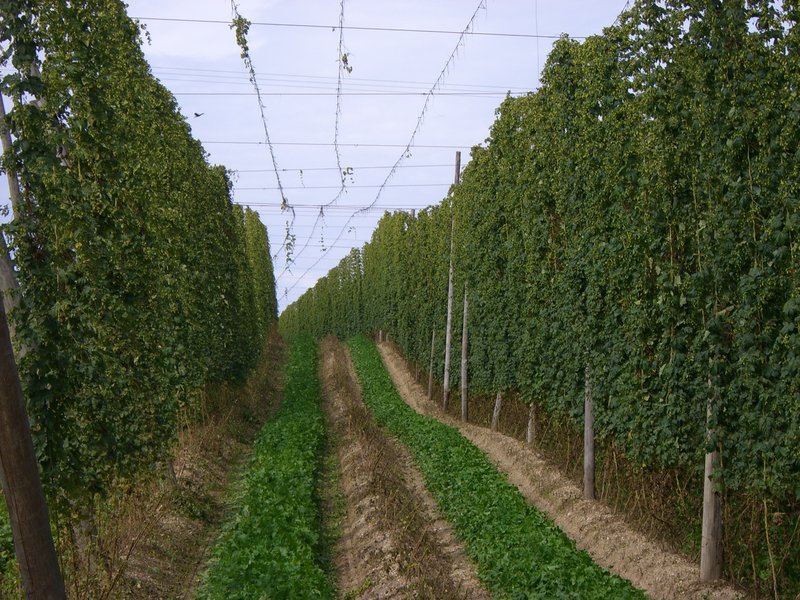
Bavaria's state institute for agriculture, the LfL, reported on 10 July that bines in numerous Herkules gardens had wilted at the top after the late-June heat. The cause was "intense solar radiation, high temperatures near 40°C and hot winds", the institute said, and "as a result, even where soil moisture was sufficient, the leaves dried out and the main shoot in the top section died off".
Across the monitoring points for the Hallertau, Tettnang and Spalt, the 30 days to 3 August ran 3.4°C to 5.9°C above the 1991–2020 normal on maximum temperature, with vapour-pressure deficit at 152 to 200 per cent of normal and topsoil moisture at 38 to 46 per cent, according to Cropli analysis of ERA5 and Open-Meteo daily observations. Rainfall is the one measure that is not historic: 14 to 16 per cent of normal over the past fortnight, but 53 to 86 per cent over 90 days.
Measured over 1 June to 3 August, 2026 is the hottest, most evaporative and driest-soil season of the six in the daily record at all five German points, beating 2022 on each — though it is drier than 2022 at only two of the five.
The crop at risk has already been cut back by its growers: the Verband Deutscher Hopfenpflanzer put German hop acreage at 17,860.94 hectares for 2026 on 11 June, down 5.81 per cent, with 904 farms left after 62 growers quit in a year. The Hallertau, at 14,765.34 hectares, is 83 per cent of the national area and largely unirrigated. In the Elbe-Saale region, where irrigation does exist, Hopsteiner reported that "many farms are actively irrigating their fields".
A short German crop would land on a market that has spent six years growing more hop than brewers want. The BarthHaas Report 2025/2026, presented in Nuremberg on 21 July, put world hop acreage for the 2025 crop down 5.5 per cent at 52,660 hectares and the harvest down 3.8 per cent at 109,188 tonnes — and still counted a surplus of roughly 1,200 tonnes of alpha acid, the bittering compound brewers actually contract for.
"Although acreage has been reduced once again, the market has yet to find equilibrium," said Heinrich Meier, the report's author. "Production exceeded demand again in 2025. We expect the current supply balance sheet once more to show a surplus of approximately 1,000 metric tons."
Uncontracted Aurora changed hands at €1.00 a kilogram and uncontracted Perle and Hallertau Tradition at €1 to €2 a kilogram in Germany, according to the BarthHaas report. The Hopfenwirtschaftsverband says unsold and undelivered inventories are stagnating at a high level in the hands of merchants and breweries, and "will continue at least until the 2027/2028 brewing year".
Behind that sits a demand problem that has little to do with weather: global beer output fell 0.7 per cent in 2025 to just under 1.9bn hectolitres while hop demand fell almost 3 per cent to about 10,700 tonnes of alpha acid, because brewers are dosing less hop per litre — 5.78 grams of alpha per hectolitre in 2022, and a projected 5.42 for 2026. German beer sales fell 6.0 per cent to about 7.8 billion litres in 2025, the steepest fall since the series began in 1993, the Federal Statistical Office reported in February.
German hops are 78 per cent contracted for 2026 but 50 per cent for 2028 and 34 per cent for 2029, the association's July report shows. "Producing hops without a reliable sales perspective is not an entrepreneurial risk in this market phase; it represents a threat to the entire industry," wrote its chairman, Pascal Piroué.
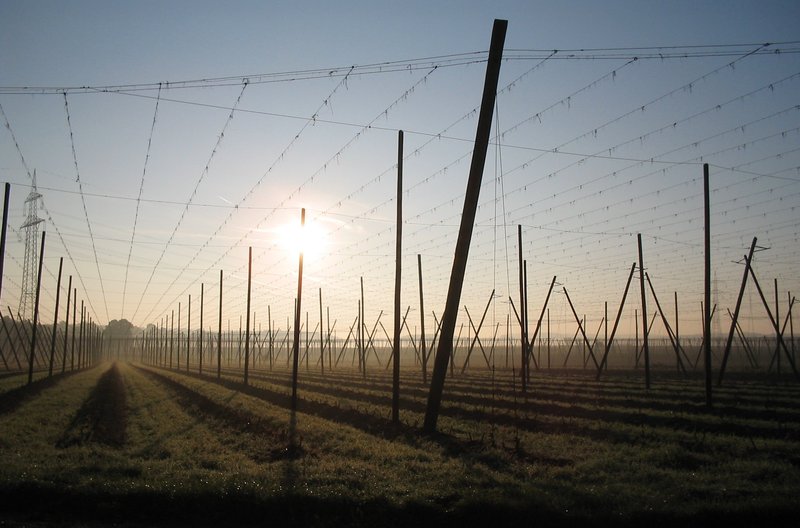
The same association issued a near-identical warning a year ago and was proved wrong. Its August 2025 report said a heatwave with temperatures above 30°C from late June to mid-July "impeded plant development and is expected to result in a somewhat below-average harvest". The 2025 German crop came in at 43,142 tonnes. On Cropli's per-point series 2026 runs well beyond 2025 — 16 days above 30°C at the Hallertau point against three, and vapour-pressure deficit of 2.23 against 1.57 — but the precedent argues for waiting on a number rather than guessing one.
Against 645.32 hectares of new planting, gross grubbing this year ran to roughly 1,746 hectares, so some of whatever tonnage is lost was removed deliberately, by growers responding to prices rather than to heat.
The fortnight that decides cone fill is not settled either. The European Centre for Medium-Range Weather Forecasts' 50-member ensemble puts median rainfall to 18 August at 32 to 47 per cent of normal across the five points, with maximum temperatures 3.0°C to 4.4°C above normal — but 20 to 38 per cent of members deliver more than 30 mm in the Hallertau and at Tettnang, and the centre's deterministic run brings 20 to 30 mm to the Hallertau, Spalt and Tettnang. Its seasonal model holds August 1.9°C to 2.6°C above the model climatology before normalising in September.
Whatever is picked will mostly leave the country. Germany exported 24,121 tonnes of hop cones, powder and pellets in 2025, worth €245.4mn, according to Eurostat data accessed via Cropli. Japan, Russia and China were the three largest destinations. A short crop is an export-book problem before it is a domestic one.
Picking in the Hallertau begins in late August. The association's July report set a longer deadline than that: "Over the next 18 months, the hop industry faces its final realistic opportunity to restore market balance through its own efforts."

