Corn for delivery to Odesa fell $8 over the past week to $200 a tonne, Spike Brokers said, while corn delivered to Chop, the rail crossing into Slovakia and Hungary, was bought at $226, down $6. "Prices for grain delivered to Odesa are now purely nominal, because there are practically no real purchases there," the brokerage said, with the main volumes moving to Chop instead.
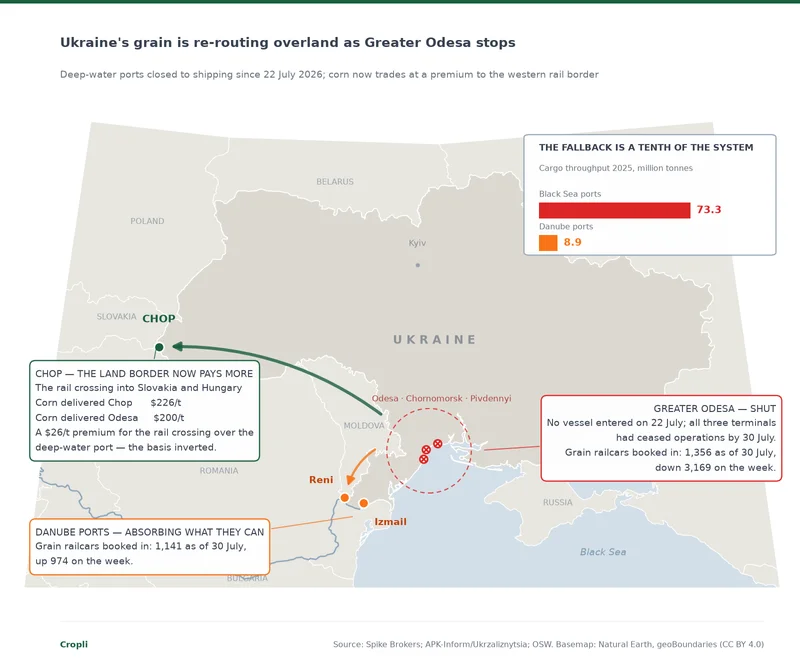
There is no formal blockade. Serhiy Derkach, first deputy minister for communities and territories, said on 29 July that the ports formally remained open but that ship calls had declined significantly. Traffic had run at four to five sailings a day in July, according to Ekonomichna Pravda; on 22 July none entered, and by 30 July the ports association Ukrport said all three Greater Odesa terminals had ceased operations.
Shipowners withdrew on their own account. Russian strikes damaged 28 commercial vessels between 20 June and 20 July and killed 21 seafarers and port workers, according to Odesa prosecutors. The bulk carrier Golden Leo, hit off Odesa on 19 July while loaded with corn, sank a week later, killing 10. Maersk rerouted its feeder service to Romania, and underwriters have stopped writing new war-risk cover for voyages to Ukrainian ports, the Warsaw-based Centre for Eastern Studies said.
"Shipowners, captains and crews now assess not the level of freight or possible earnings, but first of all the risk to life," said Dmytro Barinov, president of Ukrport.
The sharpest markdown is in oilseeds. Rapeseed delivered to Ukrainian plants fell $70 a tonne over the past week to $490, sunflower seed $15 to $680 and soybeans $14 to $445, Spike Brokers said. Domestic rapeseed reached its lowest level since November 2024, APK-Inform reported on 27 July, attributing the fall to the difficulty of exporting through the deep-water ports.
Crushers have stopped bidding rather than bid down. Many plants told APK-Inform they were not buying sunflower seed at all and had no working prices, and the reason is not the crush margin. "Because there is no understanding of the future cost of delivering the finished product, most processing plants simultaneously corrected their sunflower purchase prices," Spike Brokers said on 28 July.
The clearest volume loss so far is rapeseed. Ukraine exported about 3,800 tonnes in the first 23 days of July against 55,000 tonnes in the same period a year earlier, APK-Inform said, and has raised its estimate of August domestic processing to 200,000-250,000 tonnes from a planned 100,000-150,000 tonnes. Shipments to the EU are heavily seasonal, running at 14,038 tonnes last July before rising to 376,568 tonnes in September, according to Eurostat figures accessed via Cropli. The corridor closed at the front edge of that peak.
Purchases of sunflower oil for delivery to Black Sea ports have practically stopped, while buyers are bidding $1,320-1,335 a tonne for oil delivered to the Danube ports, Ukraine's Electronic Grain Exchange said on 29 July.
The corridor matters less to oil than to grain. Three-quarters of the sunflower oil moved by rail already leaves through western border crossings rather than ports, Ukrzaliznytsia told market participants on 16 July, attributing a 23 per cent fall in July rail oil volumes to a poor oilseed harvest and the repair season at extraction plants rather than to the ports.
Ukraine has supplied 93 per cent of the EU's imported sunflower oil this marketing year, the USDA's Foreign Agricultural Service said in April. The overland alternative is constrained for precisely these goods: Bulgaria, Romania, Slovakia, Hungary and Poland all still ban Ukrainian oilseed imports.
Kyiv is preparing loans secured against harvested crops. "Due to the suspension of exports through the ports of Great Odesa, the supply of grain on the domestic market significantly exceeded demand," Taras Vysotskyi, the agriculture minister, said on 1 August, warning that more than 27mn tonnes of agricultural products may go unexported if sea shipments do not resume.
"If the market feels that it has become safer and calmer, the ships will return," Barinov said.

