The European Commission says so itself. Its Short-Term Outlook for EU agricultural markets, published on 3 July, carries the caveat that it "does not take into account the ongoing heatwaves which are severely affecting famers all across Europe" [sic].
The other forecast is older. The US Department of Agriculture's EU Sugar Annual, published on 20 April, puts beet sugar production at 14.2mn tonnes in raw sugar equivalent for 2026/27, down 8 per cent year on year and 12 per cent from the 16.1mn tonnes of 2024/25. It attributes that to "reduced planting intentions, reflecting a market driven adjustment following the recent decline in prices", and records that spring planting was under way "under generally favorable conditions".
Behind both numbers is a three-year contraction in area that has nothing to do with this summer. EU27 sugar beet area is forecast at 1.28mn hectares for 2026/27, down 14.8 per cent from 1.50mn two years earlier, according to a country-by-country table in the USDA report. Processors in Germany, France and Belgium are running what it calls "mandatory and voluntary contraction programs" to work off carry-over stocks.
Price is the reason growers pulled back. EU average white sugar was €504.87 a tonne in May, 41 per cent below the December 2023 peak of €856.41 and the weakest monthly reading since August 2022, according to European Commission price data accessed via Cropli. That series runs about three months in arrears, so none of the drought is in it either.
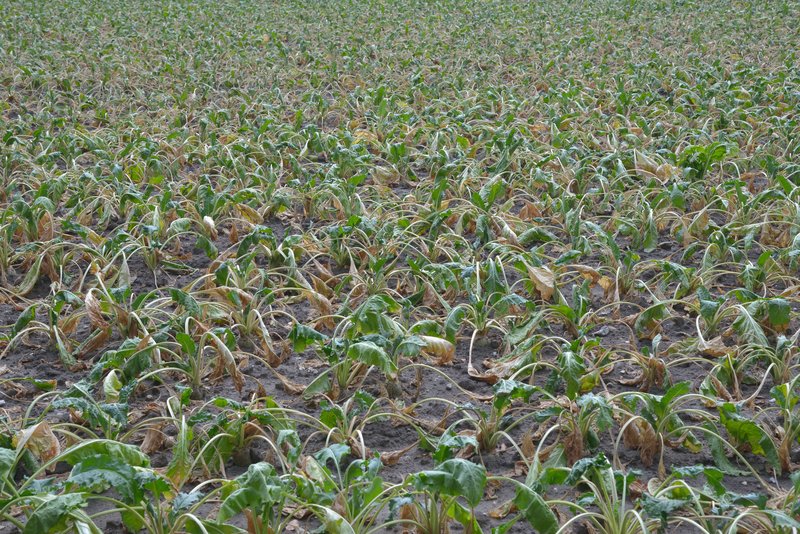
July 2026 was drier than any July since 1940 at all six of Cropli's UK sugar beet monitoring points and at three of six French ones. Newark-on-Trent recorded 2.7mm against a July mean of 58.4mm, and Amiens 7.6mm against 61.0mm. These are ERA5 grid points near the processing geography rather than national weather-station records.
Heat separates the French crop from the British one. Over the 30 days to 4 August, French monitoring points ran 4.9C to 5.4C above normal on daily maximum temperature, and five of the six recorded nine or more days above 30C. No UK point recorded more than five such days; British points ran 3.7C to 4.7C above normal, on rainfall of 5 to 12 per cent of normal.
Beet does most of its root bulking in August and is lifted from late September, so the rain that decides the crop has not fallen yet. The median of ECMWF's 50-member ensemble, in the run of 4 August, puts rainfall at Bury St Edmunds, March, Amiens and Pithiviers-le-Vieil at 28 to 43 per cent of normal for the fortnight to 18 August — an improvement on July, but not a break in the drought.
Growers were making the same point a month ago. "Water is critical for sugar beets. If it does not rain in the coming two weeks it will be catastrophic," Franck Sander, president of the French beet growers' confederation CGB, told Reuters on 1 July.
The sharpest national estimate so far is in fact a regional one. The Association of South German Sugar Beet Growers expects sugar output a third below last year, which would be the lowest since German reunification in 1990, according to the German press agency DPA; the beet is developing "a rubbery consistency" from which significantly less sugar can be extracted. Reuters separately reported a national decline of about 15 per cent. Cropli's German monitoring points sit mostly north and centre and recorded 24 to 80 per cent of normal rainfall, so they do not independently corroborate the southern estimate.
Further north the drought is severe but not unprecedented: Dutch points at Steenbergen and Dinteloord recorded 18 per cent of normal rainfall, though July was drier in 2018.
NFU Sugar and British Sugar agreed the 2026/27 UK beet contract on 15 August last year, at £30 a tonne fixed for up to 65 per cent of a grower's tonnage, £3 to £6 below the previous season depending on the option taken. The 2027/28 contract has not been announced.

