Shipments reached 54,849 tonnes in the ten months from September 2025, against 14,719 tonnes in the whole of the previous marketing year, according to US Census Bureau data accessed via Cropli. That is more than double Turkey's previous best, and 42 per cent of US in-shell walnut export volume with two months still to run.
The surge dates from 22 September, when Ankara lifted the duty days into the marketing year. Turkey bought nothing that month, 3,885 tonnes in October, then 12,082 tonnes in November, against 3,746 tonnes a year earlier. It was already California's largest in-shell market in 2023/24, with the tariff still in force, before slipping behind India.
Turkey had imposed the duty in 2018 in retaliation for US Section 232 duties on steel and aluminium. The tariffs "had been a major hurdle for U.S. tree nut exporters, costing hundreds of millions of dollars in lost sales since 2018", the US Department of Agriculture's Foreign Agricultural Service post in Ankara said in its annual tree nuts report.
Behind the easing was a shortage in domestic supply. Turkish walnut production fell 22 per cent to 47,000 tonnes after a severe frost and a dry winter, the post said, and it lifted its import forecast to 135,000 tonnes from 108,000. An off-year in Turkish pistachios added to the pull, with walnuts substituting in baklava and other desserts.
The pull is wider than Turkey. California's in-shell shipments to the Middle East and Africa rose 343 per cent over the ten months to June, with Algeria, Iraq, Morocco and the United Arab Emirates all growing faster than Turkey, on California Walnut Board figures reported by Mundus Agri. In-shell volumes to Europe fell 6 per cent.
Turkey's terms have since tightened. It raised the walnut duty to 20 per cent from 15 on 1 February and lifted the flat per-tonne tax to $451 from $416 on in-shell nuts, the Ankara post reported. Shipments held up at the higher rate through the spring before the usual seasonal taper.
Walnuts entering Turkey under an inward-processing regime for shelling, packing and re-export pay no import taxes, and US nuts moving that way "tend to be processed and re-exported to the Middle East and Africa", the post said.
The old crop is effectively sold out. Shipments and commitments together reached 102 per cent of 2025/26 crop receipts at the end of June, on Walnut Board figures reported by Expana, with the excess drawn from inventory.
Bill Carriere of Carriere Family Farms, a grower-processor at Glenn, told FreshPlaza in June he expected "a big crop, which is a bit disconcerting", and hoped for 750,000 to 775,000 tons against the 809,000 tons California utilised in 2025.
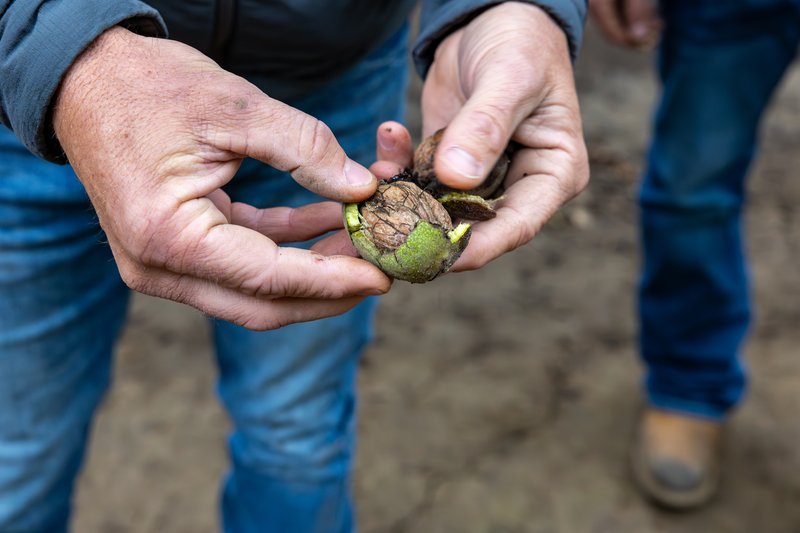
The kernels now filling are in the weeks when heat can cost growers grade money; the University of California Cooperative Extension puts the window in which kernels are sensitive to discolouration at early August to early September. The heat has so far concentrated in the south of the belt. Daily maximum temperatures at Visalia, in the southern San Joaquin Valley, ran 2.9C above the 1991-2020 normal between 15 June and 10 August, while Wheatland, in the Sacramento Valley acreage that carries most of the crop, was 0.6C below, on Cropli's monitoring data. ECMWF's 50-member ensemble gives a 74 per cent chance of another 100F day at Visalia on 23 August.
No official forecast of the 2026 crop exists. The Walnut Objective Measurement Report, which has forecast the California crop before harvest since 1958, does not appear on the National Agricultural Statistics Service's 2026 California release calendar. The first official read on this crop is the walnut, raisin and prune report due on 20 October, seven weeks after the marketing year opens.

