Shipments totalled 22,409 tonnes worth €73.2mn ($85.4mn) between January and June, compared with 3,595 tonnes in the whole of 2025, according to Eurostat customs figures accessed via Cropli.
The previous annual high in the series was 21,823 tonnes, in 2006. Morocco's share of the olive oil the bloc buys from outside its borders rose to 13.6 per cent from 1.8 per cent last year, second only to Tunisia at 78.9 per cent.
Spain took 18,798 tonnes, or 84 per cent, of the total, up from 373 tonnes in the same six months of 2025, making Morocco its third-largest supplier after Tunisia and Portugal.
Monthly volumes rose from 903 tonnes last December to 4,461 tonnes in June, Morocco's largest month into Spain since January 2006, and were still rising at the last observation.
Spanish output fell about 9 per cent in the 2025/26 season to roughly 1.3mn tonnes, according to agriculture ministry estimates reported by Euronews.
Moroccan oil landed in Spain at €3.08 a kilogram over the half-year, against an all-origin average of €3.55. The discount widened in June, to €2.84 against €3.44. The HS 1509 customs line covers every grade, from lampante, which must be refined before it is edible, to extra virgin.
The Moroccan shipments are not established as extra virgin, and the discount is consistent with lower grades bought for refining and blending.
RECORD HARVEST BEHIND EXPECTED FALL
The Fédération interprofessionnelle marocaine de l'olive, or Interprolive, on 6 August put the 2026/27 olive crop at about 1.2mn tonnes, Bladi.net reported, roughly 800,000 tonnes below last season's record 2mn.
The figures are for olives, not oil. The federation put the oil yielded by the record crop at close to 200,000 tonnes, more than double the season before, Euronews reported in July.
The record is a narrow one: FAO's Moroccan olive series peaks at 1.97mn tonnes, in 2022, and carries no figure for 2025.
The federation said carry-in stocks from the record harvest would prevent both a shortage and a price rise. It has not published the stock figure, and named no one behind the forecast.
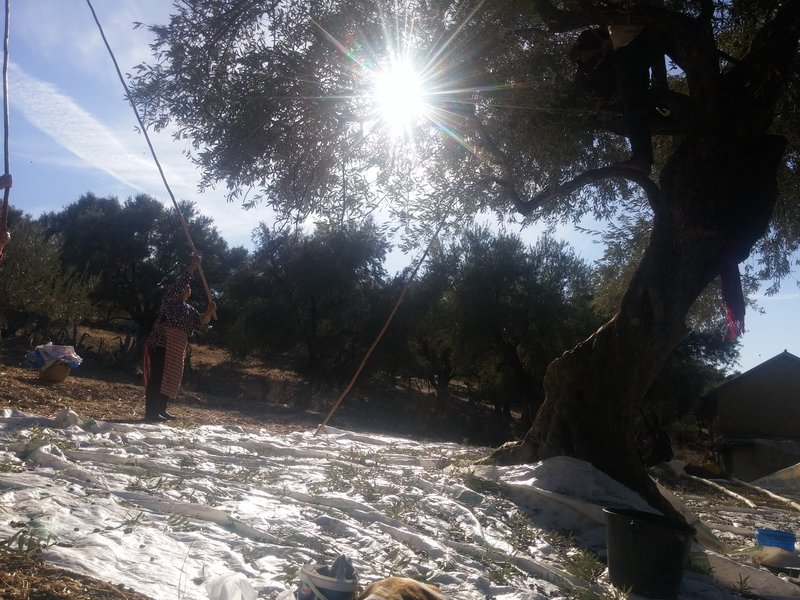
The record itself is what is cutting the crop. Morocco's 2025/26 harvest was still being picked in early February, past its normal end in late January, after December rains interrupted the work. A labour shortage pushed daily wages to as much as 200 dirhams, or about $22, at Kalaat Sraghna, Taounate and Ouezzane.
"The rains badly disrupted the pace of picking, making access to the groves difficult and considerably slowing the campaign's progress," the federation's president said in remarks carried by Hespress and reported by AgriMaroc on 2 February.
Fruit held on the tree that late denies the olive the dormancy it needs before floral induction in spring, agronomists warned, the outlet reported, sharpening the alternate bearing that already swings the crop from one year to the next.
Cropli's own measurements support that explanation. At nine points across the Moroccan olive belt, the April to mid-May flowering window ranked only 13th to 23rd warmest of 48 years, on an ERA5 reanalysis rebuild accessed via Cropli.
Rainfall over the hydrological year to 31 August was above the 1991-2020 normal at all nine points, and at Marrakech the highest in 47 years.
When Moroccan output last fell hard, in 2024/25, agriculture minister Ahmed El Bouari told parliament the causes included drought and "the heatwave that coincided with the flowering period of the olive groves", Bladi.net reported. Neither is present this year.
SPAIN MOVES AGAINST DUTY-FREE ROUTE
The surge in supply comes as Spain moves against the customs route third-country oil takes into the bloc.
Ramón Fernández-Pacheco, Andalucía's acting agriculture minister, wrote to Madrid on 2 September asking it to request that the European Commission suspend inward-processing relief on olive oil under Article 195 of Regulation (EU) No 1308/2013. The relief lets non-EU oil enter duty-free for processing before re-export.
"A distortion is being produced in the olive oil market," he said. His case concerns extra virgin, which the department argues undergoes no real processing under the relief.
It puts the share of Tunisian oil entering that way at 61.6 per cent in 2025, rising to 76.3 per cent between January and April. His letter names Tunisia, not Morocco, though any suspension would apply to third-country oil generally.
The request comes as the market hits a trough. Spanish extra virgin at origin averaged €3.46 a kilogram in the week of 24 August, the most recent quotation, down from €3.60 on 20 July and €4.04 in early September last year, and less than half the €8.39 of September 2023.
Oil is the smaller and newer half of the trade. Morocco sent the EU 50,192 tonnes of prepared table olives in 2025, more than any other country outside the bloc, in a trade that has run between 49,000 and 72,000 tonnes a year for a decade.
Meanwhile, the US took 6,271 tonnes of Moroccan oil in the first seven months of 2026, against 4,820 tonnes in the whole of 2025, lifting Morocco from ninth to fifth among its suppliers.
FORECAST CONTESTED AT HOME
The national forecast is contested inside Morocco. Growers around Ksar El Kébir, Ouezzane and Chefchaouen expect 40 to 80 per cent more fruit this season, on the winter rains and on young plantings, le360 reported on 29 August.
The outlet put those plantings at about 75 per cent of the area in two of the three districts. At Ouezzane it reported the litre of local oil not expected to exceed 35 dirhams, about €3.25, this season.
Fès-Meknès, the Oriental and Tanger-Tétouan-Al Hoceïma together account for 67 per cent of national output, El Bouari told parliament last September.
Moroccan picking does not begin until after mid-October. The US Department of Agriculture publishes no olive report for Morocco and no national estimate is scheduled, leaving the federation's the only forward number.

