Growers in Almeria and Granada were paid an average of €1.15 per kg in the 2025/26 season, the highest in 10 campaigns, according to the Andalusian regional government's price and market observatory.
Spanish fresh-tomato exports have fallen 45% over 11 campaigns while the average export price per kg has doubled, Eurostat figures accessed via Cropli show.
The €1.15 figure is a volume-weighted average across all tomato types and categories, paid to growers on delivery to the warehouse and excluding VAT, handling and sales commission. The Observatorio de Precios y Mercados calculates it from the books of 20 marketing companies, including Unica, Vicasol, CASI and Caparros Nature.
The average masks a wide swing. On the observatory's monthly series, the origin price peaked at €1.88 per kg in March and fell to €0.61 in June. The figures are as of the end of July and may still be revised.
Spain shipped 514,100 tonnes of fresh tomatoes in the September-to-June campaign just ended at an average of €1.99 per kg, compared with 930,600 tonnes at €1.00 in 2014/15, the Eurostat data show. Export value rose 10% over the 11 campaigns to €1.03bn from €928mn.
The trend continued this year. Volume fell 8.1 per cent from 559,300 tonnes in 2024/25 while unit value rose 10.2 per cent, leaving Spain with 1.3 per cent more export revenue from 45,000 tonnes less fruit.
SMALLER CROP, HIGHER COSTS
In Almería, the south-eastern province that grows most of Spain's tomatoes, the higher price did not make up for the lost crop.
Provincial tomato production fell 17.3 per cent to 940,500 tonnes on an area down 2.3 per cent at 8,550 hectares, ASAJA Almería, the local branch of the ASAJA farmers' union, said in its campaign balance on 8 July.
It put the average price up 11.6 per cent at €1.06 a kilo, a figure that covers Almería alone and is not calculated the Observatorio's way, and the value of the tomato crop down 7.7 per cent at €997mn. Tomato and pepper lost the most value of any crop in a province whose total production value rose 0.6 per cent to €3.92bn.
ASAJA blamed what it called "borrascas históricas", or historic depressions, along with the thrips Thrips parvispinus, the moth Tuta absoluta, red spider, whitefly, the brown rugose fruit virus growers call rugoso, and a general rise in costs.
The weather record supports the account of storms. El Ejido, in the Almería greenhouse belt, received 393.9mm of rain over the campaign against a 1991-2020 normal of 246.0mm, according to ERA5 reanalysis data accessed via Cropli.
The same data show 29 days with gusts of 70km/h or more and a peak of 123km/h, the highest on both counts in a daily record that begins in 2021.
COEXPHAL, the Almería association of fruit and vegetable producer organisations, which accounts for 70 per cent of the province's output and 80 per cent of its fresh exports, said the average unit cost of production across all its crops rose 4.7 per cent to €0.632 a kilo, three times the previous campaign's increase. Fuel was up 50 per cent and fertiliser 27 per cent, it said.
Over ten campaigns, regional government cost data compiled by Hortoinfo show the cost of a hectare of Almería greenhouse tomato rising from €51,400 to €80,019, and the labour on it from €21,700 to €36,826. The observatory itself describes the figures as "an approximation and never a fixed and unquestionable value".
"The 2025/26 fruit and vegetable campaign has left us a fall in production, a rise in prices and a significant increase in production costs," COEXPHAL president Juan Antonio González said when the association presented its balance on 22 July.
Tomato's price gain was neither unique nor the largest. Origin prices across COEXPHAL's members rose 12 per cent on the campaign, with courgette up 36 per cent, aubergine 31 per cent and cucumber 25 per cent against tomato's 16 per cent.
Over the same decade, the cost of producing a kilo of tomato rose 62.9 per cent while the price received for it rose 79.3 per cent. The margin on each kilo has held even if the kilos have not.
MOROCCO CLOSES THE GAP
The decline is concentrated in the markets on which Almería built its trade. Germany, still the largest destination, took 157,100 tonnes this campaign against 228,600 in 2015/16.
Shipments to the Netherlands fell to 40,200 tonnes from 102,700, and to the UK to 55,400 from 132,500, a fall of 58 per cent. Of the ten largest destinations a decade ago, only Portugal takes more Spanish tomato today, at 30,500 tonnes against 27,100.
On the import side of the same customs data, Morocco supplied 452,700 tonnes to the EU this campaign against Spain's 422,300, having first overtaken it in 2022/23.
The discount at which Moroccan fruit sells has all but disappeared. It entered the EU at €0.73 a kilo in 2012/13 against Spain's €1.16, a discount of 37 per cent. This campaign it was €2.09 against €2.15, a discount of under 3 per cent.
The series counts intra-EU trade, so it ranks suppliers to the bloc rather than imports from outside it.
The Netherlands, much of whose trade is re-exported fruit, remains the largest supplier at 515,200 tonnes. COEXPHAL said that re-export trade is itself turning, with the Dutch finding in Morocco an increasingly important origin for the fruit they ship on.
It also flagged the expansion of production around Dakhla, in Western Sahara, where it said projects now in development will significantly increase the area growing for the European market over the coming years.
Almería's growers see the record price as a product of that competition rather than of their own strength.
"Tomato and watermelon are especially sensitive to imports of production from countries such as Morocco or Senegal," ASAJA said in its balance. "When those countries go through problems arising from pests, water shortages or other factors, the entry of imported product falls and origin prices in Almería manage to hold up, which shows the degree of dependence of these crops on foreign competition."
Both origins shipped less to the EU this campaign, with Morocco's volume down 13.9 per cent and Spain's down 16.2 per cent.
On one point COEXPHAL's reading is more upbeat than the customs data support. It puts Almería's tomato sales to the UK up 11 per cent in volume, while Spanish customs record shipments to Britain falling to 55,400 tonnes from 56,400 over the same window.
The two reconcile only if the rest of Spain fell considerably harder than the 10 per cent COEXPHAL reports for its exports overall.
SMALLER AGAIN
The winter tomato campaign opening this month will be smaller again. COEXPHAL's first returns from members on autumn planting, published in June, show tomato area down another 1 per cent for 2026/27, while aubergine is up 7 per cent, courgette 3 per cent and cucumber 2 per cent.
Pepper, the largest autumn crop, is down 4 per cent. A en Verde, the Almería farming outlet that reported the survey, cited the reasons the trade data have recorded for eleven years: tomato is the most expensive crop per hectare to grow in the province, and Morocco and Turkey are taking share in Europe.
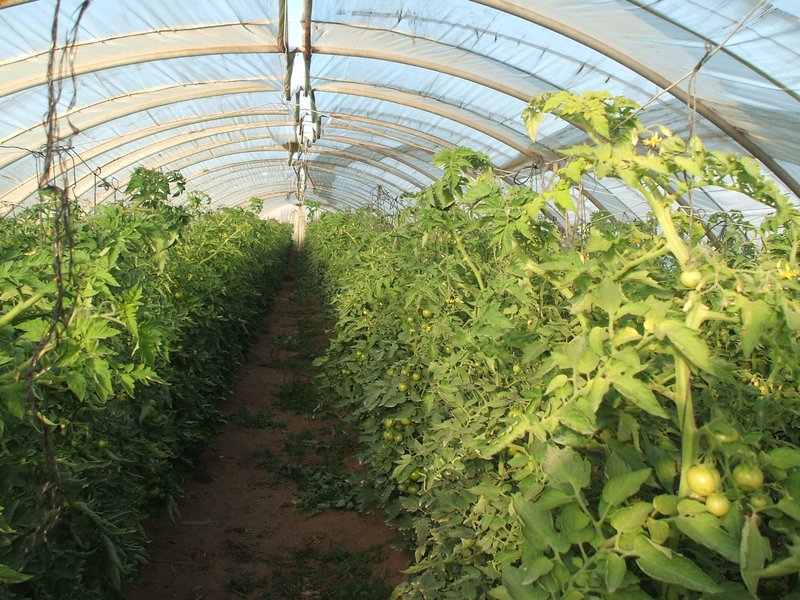
Thrips parvispinus, one of the pests ASAJA blamed for the crop just lost, is present in greenhouses across every Almería growing area as the new plants go in, but "for the time being, it is mainly confined to localized outbreaks", Fernando Paniagua Salvador, president of COITAAL, the province's association of agricultural technical engineers, said on 2 September.
That was "a significant difference compared to last year, when we found farms with a much more widespread infestation", he said, while cautioning that it was premature to predict a lighter pest year: "what happens in September, October and November will give us a much clearer picture".

