The steady price follows a heat-afflicted growing season for the region, and comes with no futures market left in which to hedge the crop after the European Energy Exchange delisted its European processing potato future on 5 June.
The new-crop quotation published by Belgapom, the Belgian potato trade association, opened at €200 in the week to 14 August and has stayed at €200 every week since, to 4 September.
It opened at €500 in 2023, €300 in 2024 and €50 in 2025, three to four weeks earlier in the season than this year. The 2023 quotation had fallen to €125 by mid-September, the 2024 quotation to €125 within four weeks and the 2025 quotation to €15 within one.
HEAT, NOT DROUGHT
Days at or above 30°C between 1 May and 7 September totalled 420 across 30 monitoring points in France, Belgium, Germany, the Netherlands and the United Kingdom, the five countries of the North-Western European Potato Growers (NEPG), according to Cropli's per-point weather data.
That is 1.7 times the previous high of 242 days in 2022, in a record that begins in 2021.
Amiens alone logged 32 such days, against 14 in 2022. Rainfall has not followed the same pattern: only three of the 30 points recorded their driest May-to-September of the six years.
Jurgen Duthoo of Warnez Potatoes, a potato trader and packer at Tielt in West Flanders, told FreshPlaza on 2 September that 2026 had not broken the rainfall deficit of the record year 1976, but that conditions were reminiscent of other dry years.
"We've had several periods of extreme temperatures this year," he said. "We've recorded three official heatwaves, which is already more than the two recorded in, for example, 2018."
The crop is short on quality as well as tonnage. "You often see that a lot of tubers were initially formed, but that underground development stopped due to the drought and heat," Duthoo said.
Batches that meet size requirements are being rejected on visual inspection for scab, he said, and a shortage of larger tubers "can also have implications for the length of the chips in the processing industry".
SPROUTING AND STORAGE
In France, where the ware potato area was cut by 9.7 per cent, the first liftings have exposed a second risk.
Antoine Geysels, director of Top Pom, a producers' group in Champagne-Ardennes, the Beauce and Hauts-de-France, told FreshPlaza on 3 September that he was seeing "particularly severe sprouting, which suggests a season in which storage will be a real challenge for operators".
Demand has been strong enough, Geysels said, "to sell the available batches at harvest while keeping the market price close to the level at which we started", with Italian packers buying and Spanish packers expected to turn to France during September.
The 2025/26 season had ended, he said, "with overall stock levels close to zero in the fresh produce market". French growers irrigate more of their crop than their neighbours do, he said, so "the impact on yields will be at least the same, if not greater" elsewhere in the belt.
The processing industry must be supplied whether or not the field crop arrives. Belgium alone exported 2.99mn tonnes of frozen potato products worth €3.45bn in 2025, according to Eurostat figures accessed via Cropli.
Much of that raw material is bought forward, so the free-market quotation is not the price every grower will receive. NEPG said in June that processors had offered ex-field contracts, for potatoes sold from the field rather than out of store, at around €125 a tonne, "whilst some growers did not have the choice but to sign contracts at those low prices".
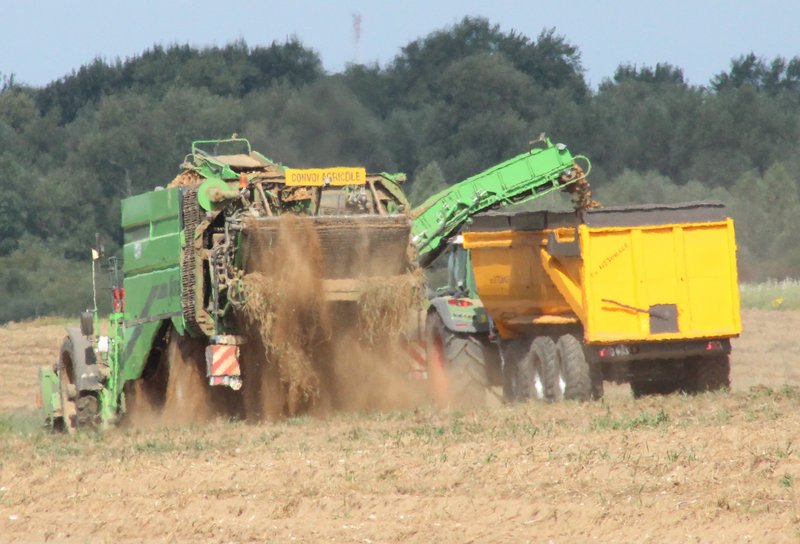
Most of the lifting remains to be done: potatoes should normally be in store by late October, Duthoo said.
In the ECMWF ensemble's 8 September run, its 51 members put median rainfall over the following fortnight at 40.8mm at Emmeloord, in the Dutch Flevoland belt, with only one member below 20mm.
At Tournai in Belgium the median is 18.4mm, with 28 members below 20mm. "A long dry spell followed by a lot of rain isn't ideal for harvesting conditions either," Duthoo said.
No estimate has yet been published for the size of the zone's crop. Duthoo would say only that "we can already say with certainty that the harvest will be smaller than last year".
NEPG's most recent statement, the June release, called a cut in the zone's ware potato area, the crop grown for consumption rather than for seed, a certainty, put provisionally at 11 per cent, but said it was "still far too early to draw any conclusions about the size of the 2026 harvest".
The association issued a September assessment in each of the past three years and has published nothing since June.
The German potato trade meets for the 73rd International Potato Autumn Exchange at the Hotel Hafen Hamburg on 29 September, where the size of the crop will be argued over.

