Yield is put at 55.4 bushels an acre against 72.6 last year, and harvested area at 5.36m acres, down 11 per cent, the National Agricultural Statistics Service said. Kansas, which accounts for 167.5mn bushels of the national total, is forecast at 67 bushels an acre against 90 last year.
NASS interviewed about 14,500 producers between 25 July and 5 August for expected yields as of 1 August. Daily maximum temperatures at seven of Cropli's eight monitoring points in the sorghum belt ran 2.6C to 4.2C above the 1991-2020 normal over those twelve days, on ERA5 reanalysis data accessed via Cropli. They ran 3.7C to 6.8C above in the nine days after interviewing closed, and the week from 15 August is forecast at 4.6C to 7.8C above, with 12 to 14 days above 35C at every one of those points.
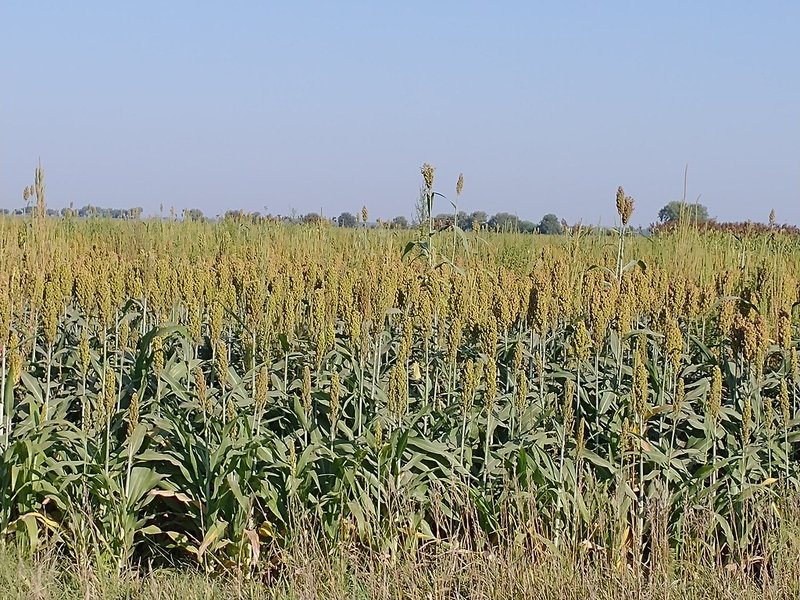
USDA publishes a reliability statistic with each forecast. The root mean square error on its August sorghum production forecast over the past 20 years is 15.0 per cent, against 3.5 per cent for corn.
Sorghum is most exposed in the fortnight it flowers. "The most sensitive time for heat stress to occur is from head emergence through flowering. This period lasts approximately 15 days," Brent Bean, director of agronomy at the United Sorghum Checkoff Program, wrote in the group's agronomy guidance. Kansas was 48 per cent headed on 9 August, behind a five-year average of 55 per cent, so more than half the state's crop reaches that stage inside the forecast heat.
The daytime half of the damage threshold is being met and the night half is not. A Kansas State University growth-chamber study cited in the same guidance halved grain set when plants saw maximum temperatures of 97F and minimum night temperatures of 79F for five consecutive days in the flowering window. Belt maxima have cleared 97F on 11 to 24 days of August at the seven points, counting the forecast, but night minima are averaging 21C to 24C, and no point meets both conditions on more than three days.
USDA rated 35 per cent of the crop good or excellent on 9 August, before the heat, against 66 per cent a year earlier, and 29 per cent very poor to poor by 2 August.
US sorghum production fell 58 per cent to 4.77mn tonnes in 2022, on heat and drought in the same belt, according to FAO data accessed via Cropli. This year's forecast is about 7.5mn tonnes.
The short crop is arriving into the strongest Chinese demand in three years. China took 3.38mn tonnes of US sorghum in the first six months of 2026, 87 per cent of everything the US shipped, against 369,000 tonnes and an 18 per cent share in the whole of 2025, according to US Census Bureau data accessed via Cropli.
Beijing had put an additional 10 per cent duty on US sorghum from 10 March 2025 under the State Council Tariff Commission's Announcement No. 2, and removed it under Announcement No. 9 with effect from 10 November of last year. "This policy shift led to a resumption of U.S. sorghum purchases by China," the USDA Foreign Agricultural Service said in its March annual report on Chinese grain and feed. The service forecasts Chinese sorghum imports at 7.8mn tonnes in 2026/27.
Country elevators in northwest Kansas bid $3.83 a bushel for US #2 sorghum on 13 August against $2.90 a year earlier, according to USDA's Agricultural Marketing Service. Corn at the same locations rose 15 to 17 per cent, narrowing sorghum's discount to corn in the northwest to 31 cents a bushel from 63 cents.
China is emptying the old crop without yet committing to the new one. It took 56,800 of the 64,500 tonnes of US sorghum shipped in the week to 6 August, but net new sales across all buyers were 3,300 tonnes, down 64 per cent on the week, the Foreign Agricultural Service reported. No sorghum was booked for the 2026/27 marketing year that begins on 1 September, though one week of sales is too thin a base to call a trend.
CME Group begins trading the first sorghum futures contract on 24 August, priced as sorghum's basis to CBOT corn, the difference between the two prices. USDA's next forecast for the crop is due in September.

