The estimate had been due on Friday 7 August. "This year, the reports coming back from the regional services underline fairly unanimously the strong, even very strong, uncertainty," the ministry's statistics and forecasting service said in comments reported by Vitisphere, translated from French.
It is the third European wine-harvest estimate to go unpublished in a week. Assoenologi, Unione Italiana Vini and ISMEA cancelled Italy's national pre-harvest forecast on 29 July, saying they would release figures only once the crop was in. The same day, Cooperativas Agro-alimentarias of Castilla-La Mancha, in Spain's largest wine region, broke with custom and published nothing. "Given the climatic circumstances, we have opted for prudence," said Juan Fuente, its sector spokesman. Neither Spain's agriculture ministry nor OIVE, the national interprofession, has published a 2026 forecast.
July was the hottest month France has recorded since its series began in 1900, at 3.8°C above the 1991-2020 normal, according to Météo-France. AEMET made it Spain's joint-hottest month of any kind since 1961, and the hottest July on record in La Rioja.
June and July were the hottest of the past 48 years at all seventeen of Cropli's monitoring points across the French and Spanish wine regions, on ERA5 reanalysis data accessed via Cropli. The largest departures over the fortnight to 11 August were in the cool-climate north, at 7.4°C above normal at Strasbourg in Alsace and 6.3°C at Haro in Rioja Alta.
Only about 15 per cent of the French vineyard is irrigated, and 67 departments were under crisis water restrictions in the first week of August, when soil drought reached record national levels, drier than the 1976 benchmark. Hail also struck about 5,000 hectares in Beaujolais and 2,700 in the Ardèche.
The heat is forecast to have peaked this week. Every member of ECMWF's ensemble put maximum temperatures above 35°C at Bordeaux and at Haro on Tuesday and Wednesday. The heat is then forecast to break on Saturday, and in northern France the break comes with rain: the ensemble gives Alsace a 4 per cent chance of taking less than 10mm over the next fifteen days, into vineyards whose fruit is still hanging. Rioja gets the temperature relief without the rain, on a 41 per cent chance of under 10mm.
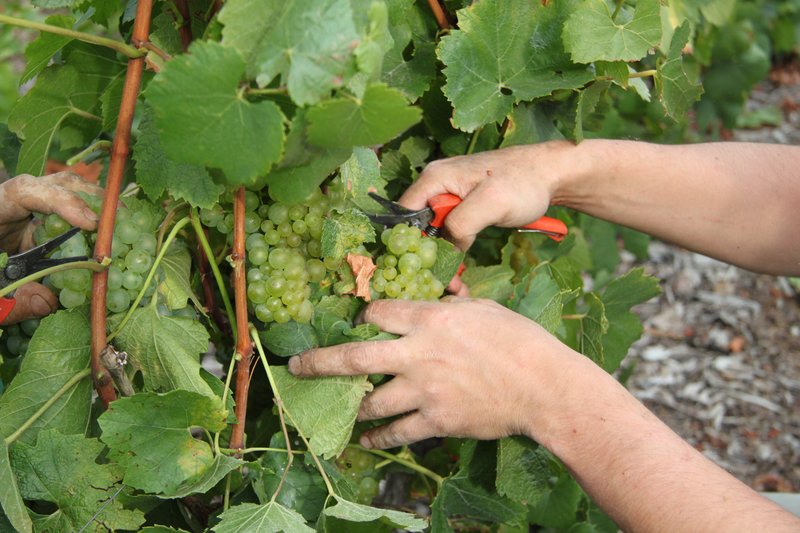
The harvest is already the earliest on record in three regions. Champagne cut its first grapes on 6 August at Montgueux, in the Aube, the earliest start in its history and made under an INAO derogation. Bordeaux opened the same day on crémant grapes, about 15 days ahead of 2025. Rioja also began on 6 August, the earliest in the denomination's recorded history. "What characterises this start of harvest is an earliness never known before, probably in every French vineyard," said Bernard Farges, president of the CIVB, the Bordeaux wine council.
The Consejo Regulador of DOCa Rioja's first maturation bulletin of the season, for all that earliness, found "a clear delay in the parameters of alcoholic ripening" against 2025. Cropli's Rioja point fits that reading: days at or above 35°C over the veraison window, the onset of ripening, more than doubled, to 19 from an average of 8.8, on a mean temperature 2.15°C above its 2021-25 average.
Champagne set its saleable yield at 8,800 kg per hectare on 22 July, before the heat peaked — a fourth consecutive annual cut from 12,000 kg in 2022, made with sector stocks at 4.8 years of shipments. Rioja has held its red-grape ceiling at 5,850 kg per hectare for a fourth straight vintage, and this year added an artificial-intelligence yield model that has ordered growers to thin their bunches. In France, 5,923 growers have applied to grub up 27,926 hectares under a €130mn scheme, 3.6 per cent of the vineyard, and 1,392 of them are leaving viticulture altogether.
The market those cuts are aimed at is shrinking in value faster than in volume. US imports of French wine fell 20.0 per cent by value in the first half of 2026, to $1.11bn, according to US Census Bureau data accessed via Cropli, while volume fell 5.8 per cent and the average value of a litre dropped to $12.31 from $14.49.
No 2026 grape price has been agreed in Rioja, with the harvest already running. UAGR-COAG, the growers' union, put the cost of producing a kilo of grapes at €1.35 last campaign against an average price received of €0.80. "Things are not solved with a snap of the fingers," said Eduardo Pérez Hoces, president of ARAG-ASAJA, which has asked the Consejo for more time on the thinning deadline.
Agreste's note is due on 8 September. Its first estimate of the 2025 crop put French production at 40mn to 42.5mn hectolitres; the final figure was 36.2mn.

